
Read Clay County Tax Records
Values start with the Clay County Board of Tax Assessors. That office maintains classifications, exemptions, and values. Collection belongs to the Tax Commissioner, who bills and takes payments. A deed price may hint at value. But it is neither the assessment nor the amount due.
| Field | What It Shows | Where |
|---|---|---|
| Fair market value | Assessor's estimate of full value | Assessment record |
| Assessed value | Tax base before exemptions | Assessment record |
| Taxable value | Value after exemptions | Notice and tax data |
| Bill and balance | Amount billed, paid, and outstanding | Tax Commissioner |
| Due date and status | Payment timing and delinquency | Tax bill |
Georgia's ordinary method assesses property at 40 percent of fair market value. Exemptions then shrink the taxable assessed value. Millage comes later. One mill equals one dollar of tax per $1,000 of assessed value. That order is why market value, sale price, assessed value, and the final tax bill are four different numbers.
Five Clay Tax Search Modes
The Clay AssuranceWeb search includes a tax-year selector. Five lookup modes are offered: name, bill, company, parcel, and address. Address mode needs both a street number and a street name. It cannot scan a whole block. For linking assessment data with billing data, the parcel search is usually cleanest.
| Mode | Entry | Best use |
|---|---|---|
| Name | Last and first | Known taxpayer |
| Bill | Bill number | Exact notice |
| Company | Entity name | Business taxpayer |
| Parcel | Parcel ID | Cross-system match |
| Address | Number and street | Known situs |
View the official tax search shown below.
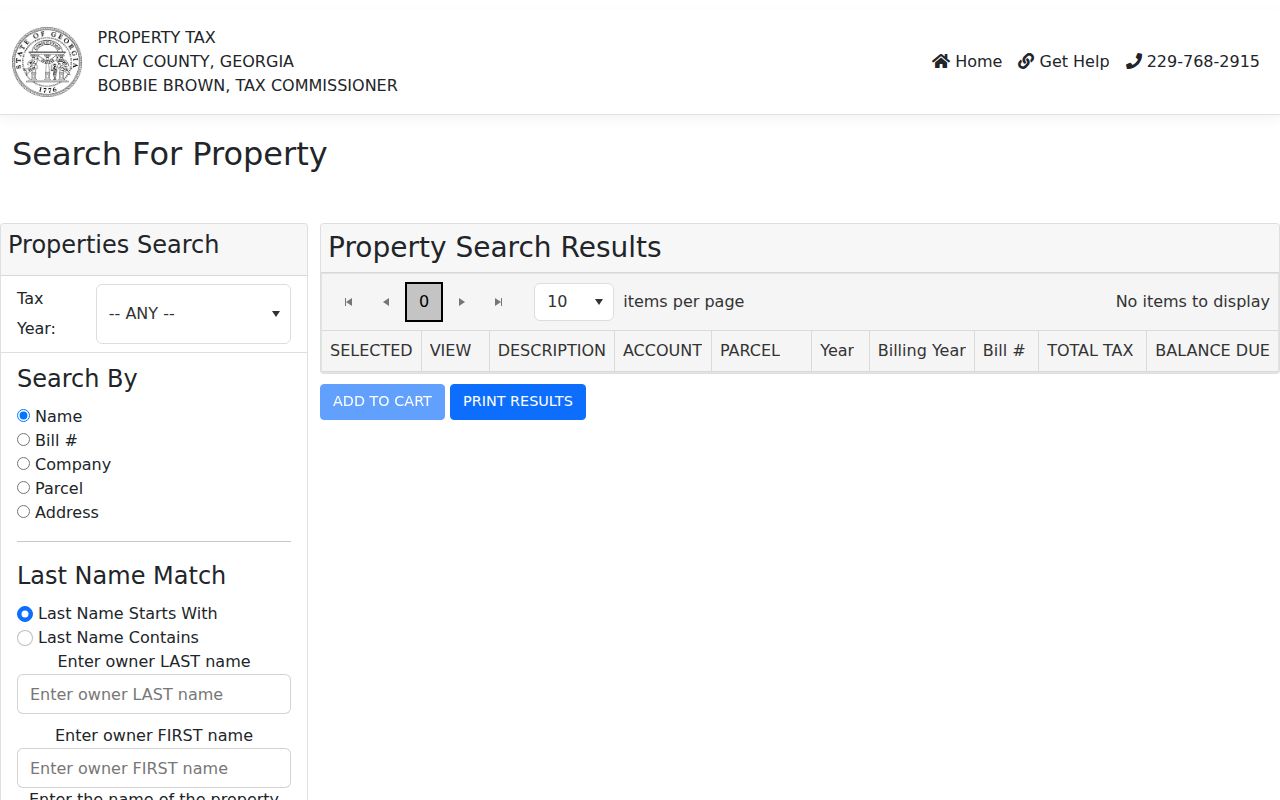
Those tabs explain why a failed address lookup deserves a second try by parcel, bill, or taxpayer name.
Clay Values Use Forty Percent
Assessed value in Georgia normally runs 40 percent of fair market value. A valid exemption can cut the taxable portion before millage is applied. The Georgia DOR property-tax FAQ covers the statewide framework, while the parcel-specific figures come from the Clay assessment record.
- Fair market value
- The assessor's estimate of full value.
- Assessed value
- Generally 40 percent of fair market value.
- Homestead exemption
- Qualified relief that lowers taxable value.
- Mill
- One dollar per $1,000 of assessed value.
A recent sale is evidence of value, never an automatic tax figure. Land, improvements, classification, exemptions, and uniformity all influence the final number.
Clay's 2026 Notice Changed
Clay County's 2026 notice compared 2025 and 2026 values. It covered both assessed and taxable assessed values under SB 566. The county emphasized it was not a tax estimate. June 22, 2026 was the mailing date. August 6, 2026 closed that appeal cycle. Owners in later years must follow the notice they actually receive. The comparison separates a value change from a bill change, and it omits final millage, exemption effects, credits, payments, and balances. Match the notice to that same year's bill before drawing any conclusion.
Note: A prior Clay County appeal date does not extend the deadline. The current assessment notice prints that deadline itself.
Find a Clay County Tax Bill
Pick the correct tax year first. Search by parcel whenever possible. Treat the result as billing data rather than a title statement, because the taxpayer can differ from the deed owner and the mailing address can differ from the property's physical location.
- Select the tax year in AssuranceWeb.
- Search by parcel or by street number and street.
- Record the bill number, due date, paid amount, balance, and status.
- Compare exemptions and value with the assessor record.
- Confirm any delinquency or sale directly with the Tax Commissioner.
- Tax year
- The billing period selected.
- Balance
- The unpaid amount shown.
- Taxpayer
- The billed party, not automatic proof of title.
- Tax lien
- A legal claim tied to unpaid tax.
Clay Returns and PT-61
Property is assessed as of January 1. Clay publishes April 1 as the annual return deadline and warns that a meter date is not enough. A mailed filing needs the required USPS postmark, or it must be hand delivered under the county procedure.
A purchaser whose transfer was filed through PT-61 may not need a separate return when no improvements or subdivision changes occurred. This explains why a recent deed and property return need not appear as parallel acts. Confirm the facts with the assessor.
Review the Clay assessor procedures shown below.
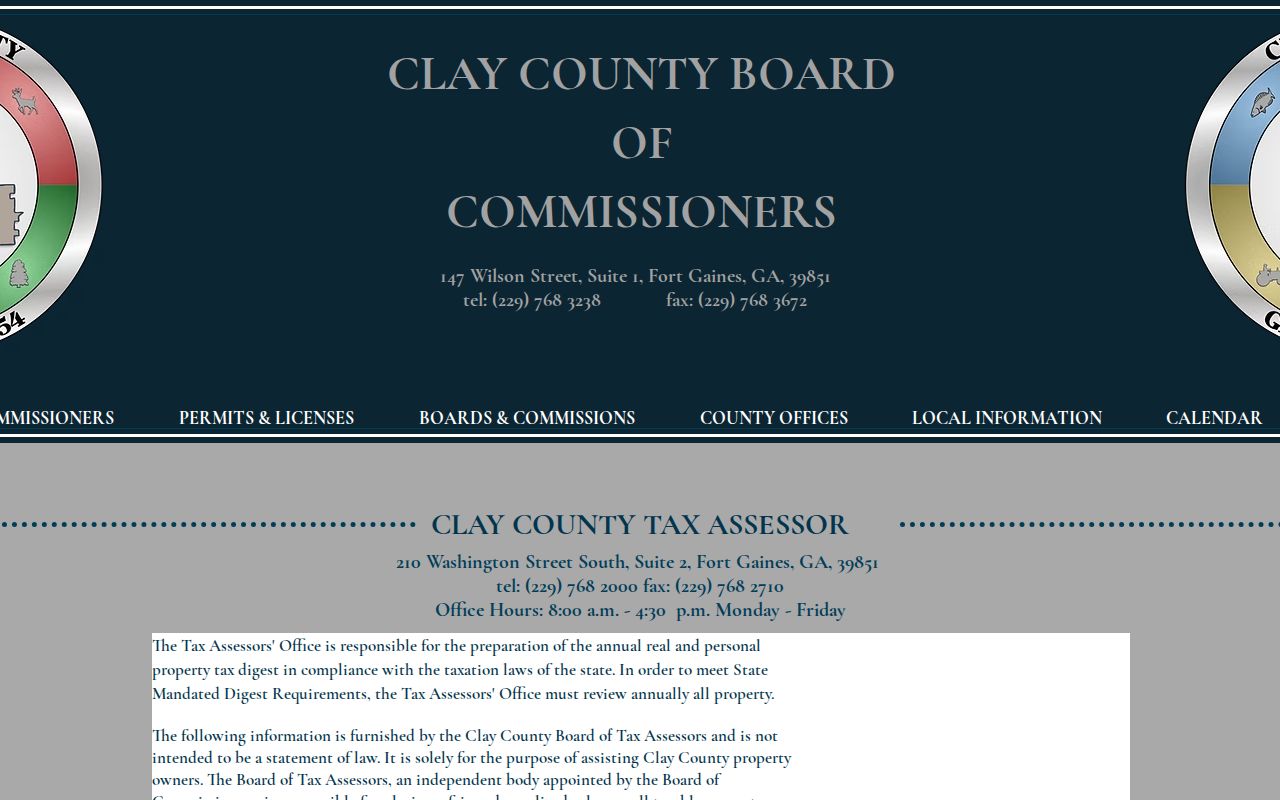
The office page answers exemption, return, and notice questions that the parcel application cannot.
Clay Exemptions and Tax Sales
Exemptions are decided on the assessment side. Apply through the assessor with current forms and evidence. A tax portal result may show the outcome, but the collector never determines eligibility. Keep the application and decision filed with the notice. An unpaid balance does not mean a tax sale is scheduled. Confirm delinquency with the Tax Commissioner. Check the county's legal organ, The Southern Tribune. Locate any recorded tax deed or court filing. Official records are the defense against urgent-payment and excess-funds scams.
Contest a Clay County Assessment
Georgia allows 45 days from the assessment notice date to appeal. File with the Clay County Board of Tax Assessors, not the Tax Commissioner. The official PT-311A form lists several grounds for appeal. These include value, uniformity, taxability, exemption denial, or breach of covenant. Strong evidence includes the notice, parcel card, photographs, and comparable sales. Add a plat or survey when acreage is disputed. Keep proof of timely delivery. Ask the office to confirm receipt, too. Open the state appeal form shown below.
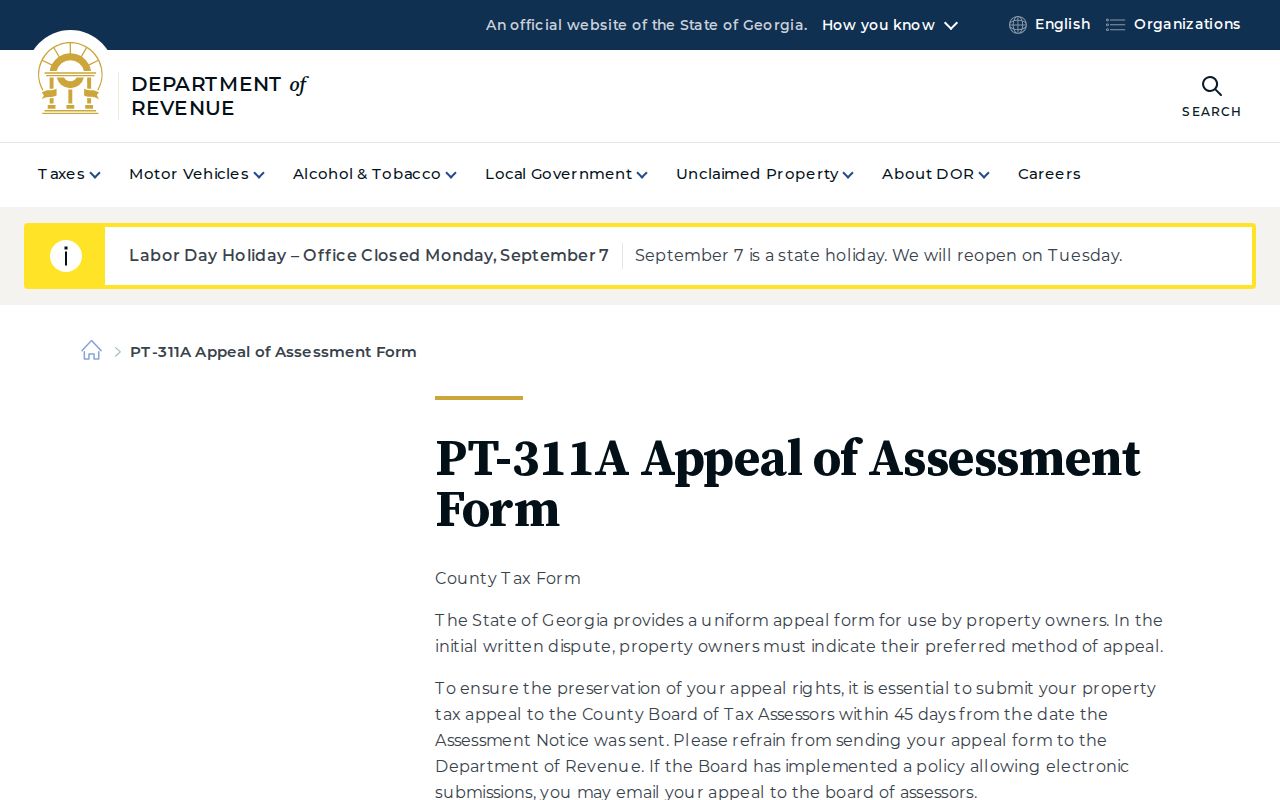
The form records the grounds selected and should be paired with the current Clay notice.
Appeal window. File within 45 days of the notice date with the Clay County Board of Tax Assessors. Missing the current date can end that cycle's appeal.
Resolve Clay Tax Record Mismatches
A mismatch is not a verdict. Treat it as a reason to compare source dates. Start by confirming that every item shares the same parcel number and tax year. Next, line up the January 1 assessment status, the deed execution and recording dates, and the assessment-notice date. Then add the bill date. A recent purchaser can appear on a deed before the roll refreshes. A taxpayer mailing name may also differ from the vested grantee.
Acreage or PIN differences point to parcel splits and combinations. Pull the deed's legal description and any plat it cites. A wrong value, exemption, or classification belongs with the assessor. A wrong billed amount, payment, or balance belongs with the Tax Commissioner. Disputed ownership is different. Rely on recorded instruments and legal advice. Do not treat property tax records as a title ruling.
For remote help, gather the parcel number, tax year, notice or bill number, and the disputed field. Bring copies of the conflicting records too. A narrow question lets the right Clay office locate an existing file. It should not need to build a custom report.
Save screenshots and downloaded records with the access date. Portal balances and annual values can shift after corrections. Payments, exemptions, or a later digest update can also change them. Request a correction by naming the exact field and explaining the conflict. Attach the deed, notice, receipt, or exemption decision behind it. Keep the office response with the corrected record.
When nothing appears online, start with the office that owns the field. The assessor supplies the current parcel card and the annual value fields. It also covers classification, exemptions, notice, and appeal material. The Tax Commissioner handles the bill and the account history. That office also covers paid amount, balance, delinquency status, and excess funds. The Superior Court Clerk holds tax-sale deeds and later recorded transfers. Request each record from its custodian and keep the response date.
A Georgia Open Records Act request should name an existing record. Include the parcel, tax year, and preferred format. Official guidance allows reasonable retrieval charges after the first 15 minutes. Copies are generally capped at 25 cents per page. Certified documents, oversized maps, media, and mailing follow separate schedules. Ask for an itemized estimate and the current payment method before placing a large order.
Keep the assessment notice and the tax bill separate. The notice supports review of value, uniformity, taxability, and exemptions. The bill reflects the later collection calculation for a tax year and district. One can change while the other stands still. Ask for a corrected copy and its effective date.