
What Clay County Deeds Show
The Clay County Clerk of Superior Court serves as the county recorder. Each filing in its real-estate records names the parties and lists the instrument type. It gives the recording date too. It also carries either a land description or a reference to a prior record. Type matters a great deal here. A warranty deed, a quitclaim deed, an estate deed, and a tax deed all rest on different events. Each makes different promises about the land. Security deeds and liens appear in the same records. But they encumber property rather than pass ordinary title.
| Deed Type | What It Does | Common Use |
|---|---|---|
| Warranty deed | Conveys the stated interest with title covenants. | Arm's-length sale |
| Quitclaim deed | Conveys only the interest the signer may hold. | Family transfer or title cleanup |
| Security deed | Secures a debt against the real estate. | Mortgage financing |
| Executor or administrator deed | Transfers land through an estate representative. | Probate disposition |
| Tax or sheriff's deed | Documents a transfer following a legal sale process. | Delinquency or execution sale |
An index entry only proves an instrument was recorded. It cannot settle competing claims, hidden defects, or rights that never reached the record. So read the actual image. Names alone can link strangers, while the legal description, the prior deed reference, and the parcel context tie a document to real land.
Clay County GSCCCA Search Fields
The GSCCCA real-estate name search is the modern route into the statewide index. Pick Clay County. Set grantor or grantee. Type the party name, and narrow the date span. The instrument-type filter helps when a common name returns too much noise. The official program description states that statewide transactions are indexed from at least January 1, 1999. Older records are still being added. Clay County's own earliest online date is not published.
| Control | Use in a Clay search | Practical caution |
|---|---|---|
| County | Limit results to Clay | Pre-1854 land may be elsewhere |
| Party type | Choose grantor or grantee | Run both roles for a full chain |
| Instrument type | Focus on deeds, liens, or releases | Over-filtering can hide a transfer |
| Date range | Bracket a likely transaction | Online coverage is not the whole archive |
When a later deed cites a prior reference, the book-and-page search is the quicker path. The official lookup screen handles those direct retrievals. Open the official GSCCCA book-and-page search.
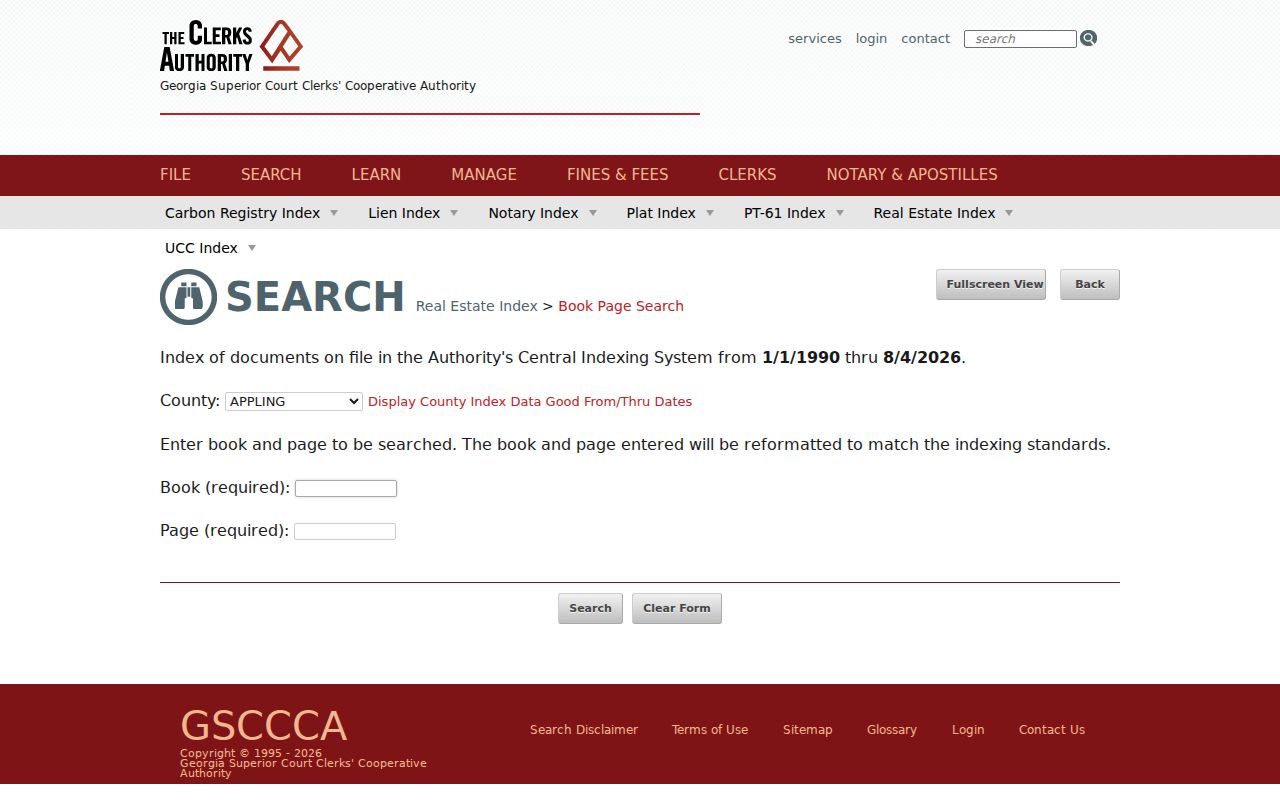
The county selector plus the citation fields turn a copied reference into a precise retrieval.
Clay County Security Deed Trails
Georgia lenders usually take a security deed to back a real-estate loan. Search both the borrower and the lender. Then look for assignments, modifications, cancellations, and releases that came later. An owner-only search can miss an encumbrance indexed under a lender or an assignee. So match any release to the original book-and-page or instrument number rather than to a similar name. The separate GSCCCA lien search allows debtor or claimant roles plus instrument-type filters. Those results add useful context to Clay County deed records. Still, a lien filing is not a deed transfer. Keep an encumbrance timeline beside the ownership chain so every document keeps its proper role. Note: Search lender, assignee, and claimant names. Do this whenever an owner-only search leaves a security deed or lien unresolved.
Clay Deed Books Before 1999
Online results are one access channel among several. The GSCCCA program reports broad statewide indexing since 1999, but Clay's exact older coverage is unconfirmed. When the portal stops, ask the Clerk of Superior Court for the direct or reverse index, deed book, plat book, or image you need. The office sits at 210 Washington Street South, Suite 3, Fort Gaines, GA 39851, and its published telephone number is 229-768-2631. For remote requests, give the clerk party names, an estimated year, the instrument type, and any book/page citation. A Georgia Open Records Act request can seek an existing record, though it cannot force the office to assemble a new title chain. Older material also runs through the Georgia Archives research guidance, county microfilm cards, and the FamilySearch Clay catalog.
Clay County Began in 1854
Clay County was created from Early and Randolph counties in 1854. That date changes the search plan. A chain that reaches beyond the county's creation may continue in the predecessor county rather than vanish from the record. Search the earlier grantor in Early or Randolph, and compare land-lot, district, acreage, and boundary language before joining the instruments.
The historic collection also includes Court of Ordinary minutes from 1854 through 1911. Books A-B cover 1854-1889, and Books C-D cover 1889-1911 in the cataloged microfilm. Probate orders can explain an administrator's deed or a transfer that does not follow an ordinary sale. Newspapers from the Fort Gaines Tribune beginning in 1883 through later Clay titles can supply legal-notice context, but the deed or court order remains the controlling recorded source.
Follow Clay Grantors and Grantees
Start from the newest reliable Clay County deed reference. An assessment card may hint at a party or a sale. But the deed index holds the recorded transfer. Work backward one instrument at a time. Keep exact spellings, middle initials, entity suffixes, and every citation intact. An estate, trust, or business may enter the chain. Search that exact named party. Treat probate or business records as supporting context.
- Find the present owner's acquiring deed by searching that owner as grantee.
- Read the grantor and the prior deed reference from the image.
- Search that grantor as a grantee in an earlier date span, then compare legal descriptions.
- Repeat until the online index ends, then continue in reverse indexes, deed books, microfilm, or predecessor counties.
- Grantor
- The party transferring a recorded interest.
- Grantee
- The party receiving that interest.
- Chain of title
- The linked sequence of instruments affecting the same land.
- Book/page or instrument number
- The filing citation used to retrieve the recorded document.
Parcel numbers can change after a split or combine. Legal descriptions and prior citations make stronger chain links than a modern PIN. For address mechanics generally, use the Clay County property search.
Plats Complete Clay Deed Records
A Clay County deed often points to something beyond itself. It may cite a subdivision plat. It may also cite a land lot and district, lot and block, metes-and-bounds calls, an easement, or an adjoining owner. When the deed says the land is shown on a plat, pull that plat. The GSCCCA plat-name search lets you query by county, name, instrument, land lot, district, or date. The plat can show lot geometry. It also shows roads, access strips, and survey references the deed only abbreviates.
A tax map is useful for orientation. But its drawn line never replaces the plat, the deed itself, or a current survey. For old town lots, Fort Gaines' 1900 Sanborn sheet can clarify a block, a building's use, or street context. It cannot establish today's parcel edge. Match those historic map clues to the recorded legal description. Never treat an old footprint as current title.
Estate Deeds in Clay County
A named owner of record has died. The next deed may still move ahead in several ways. It can pass through an executor, an administrator, an heir, or a court order. Those instruments leave their own trail. The Clay County Probate Court holds wills, estate files, guardianships, and related records. Its address is 210 Washington Street, Suite 1 in Fort Gaines. Search the probate minutes or the estate file for the authority behind the deed. Then return to the deed records and follow the land instrument itself.
This branch matters most in two situations. A name may vanish from the deed chain, or several heirs may sign. The probate file explains the transfer without letting an obituary stand as proof of ownership. The recorded deed, the legal description, and the probate authority must all agree.
Obtain a Clay County Deed
Start with the online image when GSCCCA supplies one. If the image is missing, illegible, or older than the indexed range, request a certified copy instead. Contact the Clerk of Superior Court. The Fort Gaines counter is the clearest fallback in person. Call ahead to confirm the citation, available format, current charge, accepted payment, and mail instructions. The county publishes no complete deed-copy fee schedule.
Put the essentials in any written request. List grantor and grantee, recording year, document type, book and page or instrument number, a property description if known, whether certification is needed, plus a return address and contact details. The office retrieves existing records. It does not research chains of title or answer legal questions about ownership. The Georgia open-government FAQ lays out copying, retrieval, and redaction principles for public-record requests.
Recorded, not guaranteed. A Clay County index entry confirms filing, not clear title. Unrecorded interests, defects, or later instruments may exist, so a records search is not a title opinion.
Clay County offers no official property-fraud alert signup. Before sharing personal or payment details with any alert service, verify it against the clerk's official directory.