
Build a Clay County Former-Owner Timeline
Every timeline begins with one real transfer. Then it moves back a single deed at a time. Build a working table for the chain. Each link should carry a date, both parties, the instrument type, and a citation you can retrace. Resist guessing. An assumed family tie is not evidence of ownership. Neither is a name lifted from a tax card. The Clerk of Superior Court records Clay County deeds and related land instruments. Probate files, plats, tax rolls, and newspaper notices explain the transfers that never fit a clean sale sequence.
| Transfer date | Grantor to grantee | Instrument | Book/page or reference |
|---|---|---|---|
| Newest filing | Most recent seller to buyer | Warranty, quitclaim, estate, sheriff, tax-sale, or other deed | Copy exactly from the index |
| Prior acquisition | That seller's seller to that seller | The earlier acquisition instrument | Follow cited prior book/page |
| Explanatory event | Estate, trustee, court, or enforcing party | Probate order, foreclosure, sheriff, or tax instrument | Pair case or estate file with deed |
| Archival branch | Earlier indexed parties | Historic deed book, plat, tax digest, or land grant | Repository, volume, page, and image |
This structure keeps true former owners separate from lienholders, trustees, witnesses, and neighboring landowners. A break in the chain stays visible instead of getting papered over.
Turn Each Clay County Grantor Into the Next Search
The GSCCCA grantor-grantee index powers the backward search. Set the county to Clay. Copy party names exactly, and use the date and instrument filters to cut the noise. A current deed names the grantee who received the land. The grantor is the one who conveyed it. Next, search that grantor as an earlier grantee. Confirm the legal description still matches the parcel.
- Begin with the newest deed and record the grantee, grantor, recording date, instrument type, and book/page.
- Compare the full legal description, acreage, land lot or district, subdivision, and referenced plat.
- Search the grantor as a grantee in an earlier period and inspect the best matching deed.
- Repeat until the online evidence ends, then carry the last sound citation to the clerk or archive.
- Grantor
- The party conveying an interest in the instrument.
- Grantee
- The party receiving the interest stated in the instrument.
- Reverse index
- An index organized to help find the prior conveyance by party role.
- Chain of title
- The linked sequence of instruments affecting the same land.
- Warranty and quitclaim
- Different deed forms whose legal effect must be read from the document, not inferred from the label.
Respect the Clay County Online Coverage Boundary
GSCCCA states that its statewide real-estate system holds transactions since at least January 1, 1999. Historical material is still being added. The live interface also shows a central date range beginning in 1990. Neither figure fixes Clay County's earliest online deed. Treat 1999 as nominal statewide coverage. Welcome anything older, and ask the clerk about Clay-specific completeness before trusting the chain.
A miss online proves nothing. No hit does not mean no deed ever existed. Run name variants, both party roles, broad dates, book and page, subdivision, and instrument type. Then ask the clerk directly whether the index, book, film, or loose record sits at the courthouse.
Coverage limit. Clay County's precise pre-1999 online cutoff is unpublished; older former owners may remain in deed books, microfilm, or archival copies.
Read Clay County Deed Index Controls Before the Image
The index form narrows results by party type, instrument type, Clay County, date range, and searchable name. Result-count and display controls sit alongside. An index row points to a recording; it is not the deed itself. Images can require a GSCCCA account or subscription, and no Clay-specific copy fee is published. Ask the clerk the current charge for uncertified, certified, or image prints before ordering.
The official Clay-compatible name search appears below. Its party-role and instrument filters matter for former-owner work. They keep a lender or claimant from being mistaken for an owner of record.
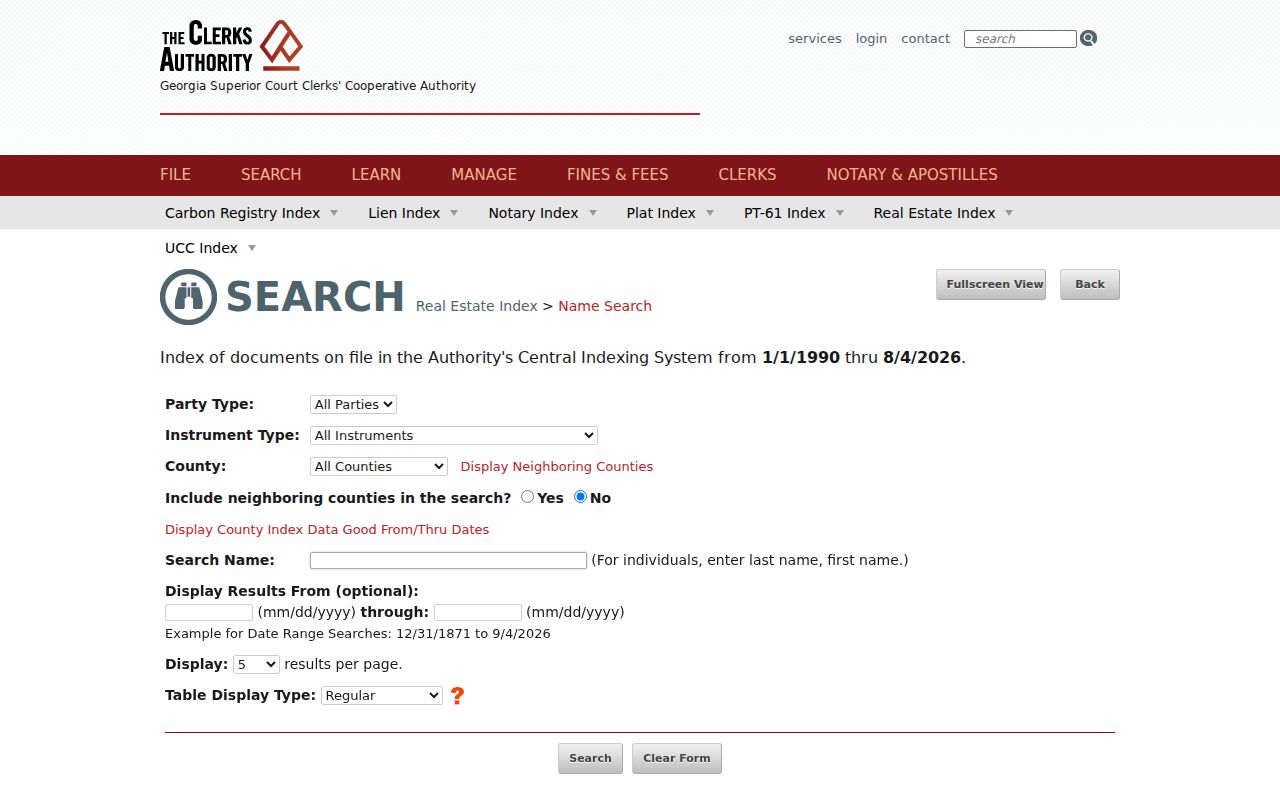
Treat the screenshot as orientation only. Read the live controls and current access terms, then cite the resulting book and page or instrument reference in your timeline.
Anchor Clay County Previous Owners With Book and Page
A book-and-page citation outlasts changes in street spelling, mailing city, and parcel numbering. The GSCCCA book and page search pulls an indexed instrument once you hold the citation. It shines when one deed expressly cites an earlier deed. Copy the book, page, county, and instrument type. Then copy the dates, parties, and legal description straight from the record itself.
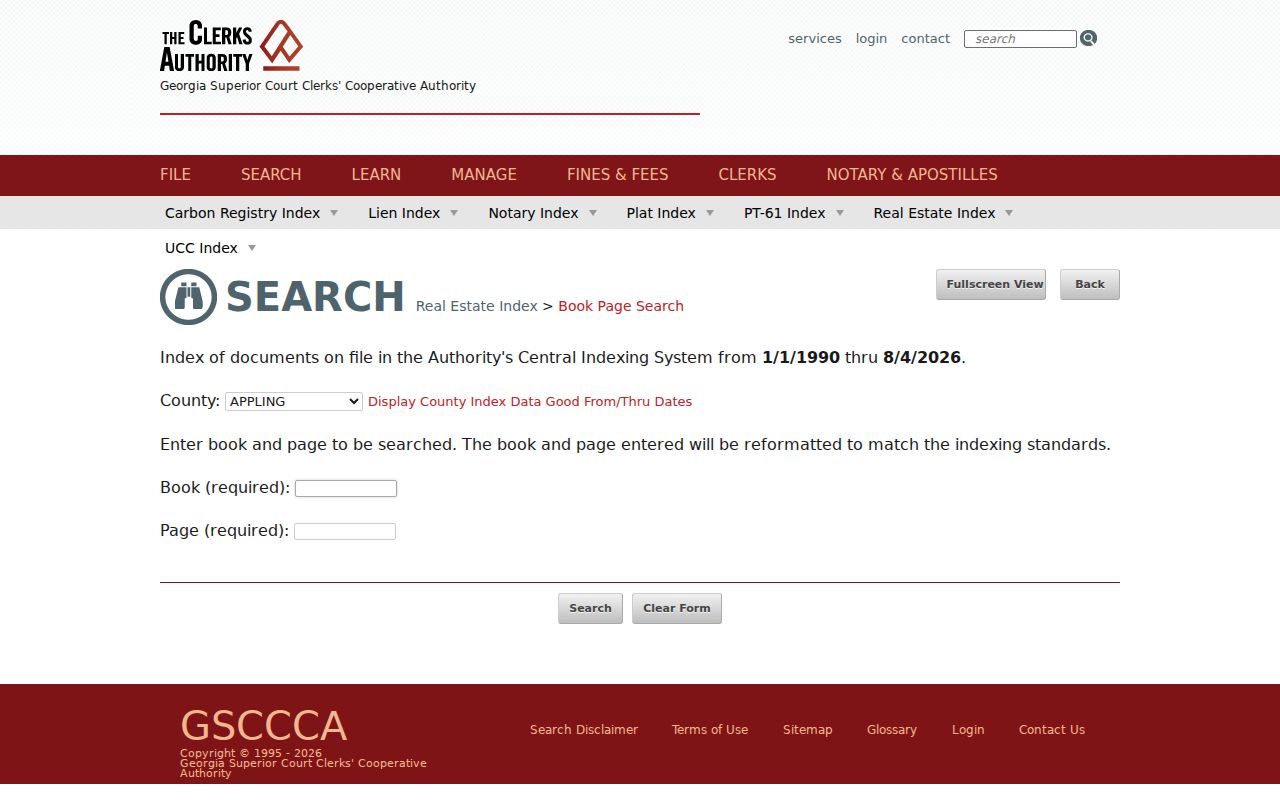
The book-page form turns a durable citation into the next document. If it will not return an older Clay volume, take that exact citation to the Clerk of Superior Court rather than substituting a similar name result.
Note: Addresses change, but a verified deed citation with a matching legal description preserves the ownership link.
Bridge Clay County Estate Breaks in the Owner Chain
A deceased owner can vanish from a normal sale sequence. Clay Probate Court holds public estate material. It includes admitted wills, letters, inventories, petitions, orders, and administrator or executor records where applicable. Search the decedent's name and the estate or administrator name. Then compare the probate order with any deed from the estate. A will held only for safekeeping stays private under the county's rules.
FamilySearch catalogs Clay Court of Ordinary and Probate minutes from 1854 through 1911. The coverage spans Books A-B for 1854-1889 and C-D for 1889-1911. Those films can surface administrators, guardians, estate land, and the court's authority for a transfer. They explain a gap. But the recorded deed or court order must still tie to the same legal description.
Follow Clay County Owners Before 1854
Clay County was carved from parts of Early and Randolph Counties in 1854. A chain reaching that line may continue in predecessor-county deed books rather than dead-end. Carry forward the last verified names, land lot, district, acreage, watercourse, road, and neighboring-owner calls. Search Georgia Archives microfilm cards, the FamilySearch Clay catalog, and Georgia headright or bounty land-grant material for the older jurisdiction.
That is the heart of Clay County ownership history. A modern parcel number can lead to a deed book, then to district or land-grant language older than the county itself. Record the jurisdiction shift in the timeline. Never invent a missing Clay conveyance to cover it.
Explain Clay County Prior Owners With Plats and Notices
Plats are powerful for past-owner work. A recorded plat ties a former owner to a lot, block, or subdivision. It also covers easements and dedicated streets. The GSCCCA plat search lets you filter by county, name, and instrument. You can also narrow by land lot, district, and date. For a Fort Gaines town parcel, the 1900 Sanborn sheet can clarify old blocks. It can also clarify building uses. It cannot establish title or today's parcel fabric.
Old newspapers fill in the why behind a deed. Georgia Historic Newspapers carries Clay coverage from the Fort Gaines Tribune, starting in 1883. Coverage runs through the Southwest Georgian, ending in 1929. Estate, sheriff, tax-sale, and boundary notices often explain a transfer. They show why a new party appeared on the land. Pair each notice with the resulting deed or court order. Add that person to your previous-owner sequence only then.
Mark Gaps in Clay County Former-Owner Research
Clay County publishes no populated online deed results, and no exact pre-1999 cutoff is stated. So label the unverified steps honestly. Keep a log of searched spellings, dates, roles, instrument types, repositories, and negative results. Distinguish an unlocated deed from a deed that never existed, and from a transfer that moved through probate or court authority.
Former-owner research supports house history, estate work, boundary questions, and purchase diligence. It is never permission to track or pressure a living person. A rebuilt timeline is not a title opinion, either. Unresolved deeds, liens, heirs, or survey problems may call for a professional examination.
Lawful use. Use prior-owner records for legitimate property research, and never use names, addresses, or family details to stalk, harass, threaten, or harm anyone.